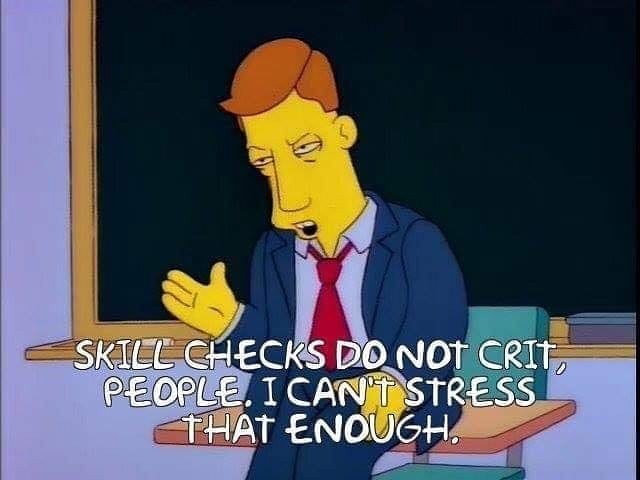
(in D&D at least)
It’s technically homebrew, but basically every table Ive played at will give you a little bonus if you roll a 20 for a check and a little negative if you roll a 1. But we still kept that a 20 does not necessarily mean an auto success and a 1 is not necessarily an auto failure. You still need to beat the DC
Agreed, auto success on a skill check nerfs challenges.
If the DC is so high that the PC doesn’t succeed with a 20, it seems too random to give it to them.
Then again, it depends on the situation: a nat 20 trying to convince the penny pinching tavern owner to give you a discount seems like fun even if the DC should be infinite; but when dealing with something story related, I’d stick a little closer to the rules.
But at the same time, if the DC is so high that no roll could succeed, then they shouldn’t be rolling for it in the first place
You’re right, but I don’t know most of my PCs stats. If the DC on a lock is 21, I’d expect a rogue might make it, but another PC who has never picked a lock wouldn’t.


I recall a Zee Bashew video that I can’t seem to find that referenced a chart of how willing someone was to help when requested. The idea being the scale isn’t from “I will actively hinder you” to “I will sell my estate to aid you” but rather from less then helpful to more helpful.
For example, if you asked some haggard clerk about a quest the scale might be:
- Critical failure, the clerk directs you to the job board for details on any job.
- Failure, the clerk may point out there specific job on the board and direct you to it.
- Success, the clerk tells you that the person who posted the job is staying somewhere in town.
- Critical success, the clerk may share a rumor they heard in addition to telling you where the poster may be staying.
Regarding a discount from a penny-pinching inn keeper, perhaps it could go:
- Critical failure, payment for the entire stay is required up front. Extending your stay is not permitted.
- Failure, They are not willing to lower their prices
- Success, they will offer a lower price if you bundle extra services like meals, drinks, and baths.
- Critical success, they will offer you the bundle rate without bundling.
They absolutely do, and the bonus effects are listed in the description of each skill action. Oh. you mean in D&D. washes hands

Dating back to 3rd critical skill checks in D&D suck because a lot of skills are written as pass/fail.
Example: picking a lock. If we want to add criticals, a 1 breaks the lock; mostly okay, with the long acknowledged fringe problem of experts being incompetent 5% of the time. What does a natural 20 get? I adore opportunities to be creative, but there’s not a lot better than, “You did it perfectly.” A regular success earns that according to the rules, I don’t want to take it away. A speech about how cool and ninja the PC is can come off pretty cringey to me. The correct mechanical answer would be to let the 20 roll over to the next check because the PC’s in the zone or whatever. Not awful, but it doesn’t directly reward the player right when they rolled the 20, which is the occurrence we want to feel good. We’re also rewriting several rules at this point.
Meanwhile, PF2e baked degrees of success into everything. On a crit fail they break the lock, on a fail they leave traces of their fruitless efforts, on a success they get one success toward opening the lock while scuffing it up a little, and on a crit success they get two successes and leave the lock looking pristine. The players don’t feel cheated when they get a normal success and scuff up the lock. The 20 has some reward for most characters. The 1 has a setback, even a reasonable setback for an expert with a +25 trying to open the DC 10 lock on Grandma’s rickety shed.
I actually don’t mind pass/fail rolls in D&D or other games. Rolling a 20 is inherently satisfying to me and I don’t mind if not every roll has fifty possible branching results. But I recognize I’m in the minority and I very much like the DC+10 critical threshold because I often like my very high skill bonus giving me additional perks even if I was only moderately lucky and rolled an 18.
They do in PF2e. And it rocks

🤓 Pedant mode activated 🤓
🤓 Erm, ackshually, a natural 20 only increases the degree of success by one. This means, for example, if someone rolls a 20 on an attack roll, the total with modifiers is 28, and the defender’s AC is 30, the attack will be bumped up from a failure to a normal success, not a critical success. 🤓🤓🤓🤓🤓
To be even more pedantic: the original poster’s meme says skill checks don’t crit, not that nat 20s on skills are a critical success. Most skill checks in PF2e have a critical success tier. Thus jagermo was correct when they said that skill checks do crit in PF2e.
That being said, you are correct about how the whole tiering mechanic works and a nat 20 not always being a critical success. :)

D&D has all the money in the entire hobby, basically, and they still make terrible design decisions like this.
Rolling a nat 20 and getting a crit is the jackpot of d&d mechanics. Don’t design a system where sometimes you hit the jackpot but don’t win anything. That’s an objectively bad choice to make.

I 90% agree. I think most of the opposition to this comes from people exhausted with habitual boundary-pushers who think that a nat 20 means they can get away with defying the laws of reality.
Like, no, a nat20 persuasion does not convince the merchant to give you half his stock and all the money in the register… He would go broke and he’s got a family to support, along with his own survival that your nat20 does not also convince him to stop caring about.
But at the end of the day, a lot of GMs who are sick of that need to be sent the dictionary page for the word “no.” The occasional use of it really does improve the quality of the game, and I’m sure plenty of players will appreciate not letting aforementioned boundry pushers continue to waste time on impossible pursuits that do nothing to move the game forward.
I’ve seen this easily solved by assuming the 20 succeedes but the DM decides how exactly.
“Okay. The dragon loves you know. They realize you have their old lover’s eyes. You remember this too. Old tales in your family that you thought were a joke. You are apparently related. And they do love you now.”
If you can’t trust your players to act like adults and show some basic maturity. That’s a different issue.
This is also a great way to handle it; malicious compliance/monkey paw. Makes for some humorous moments.
And yeah, if a player is constantly having to be told no, a talk may need to be had, and if it can’t be resolved, they probably need to go. It’s also a reason why Session 0’s are so important; talking out what’s expected of the campaign both on the part of the players and what the GM has in mind.
“No” needs to be said before the roll, IMO. Then If the player insists on doing something impossible anyway, just role-play the failure. With that said, actions that are in a narrow sense impossible can still have positive outcomes and if there’s the potential for that then I’d say roll for it. The proverbial dragon seduction attempt can still possibly flatter a dragon with a big ego enough to benefit the PC even if it doesn’t get the PC laid.

You need to qualify this statement with what you believe should happen on a nat 20.
what you believe should happen on a nat 20.
Consistency.
My point is that setting up the expectation of a moment of triumph and then diluting it with exceptions is going to create moments of disappointment at the table.
If a nat 20 is going to be a big win it should always be a big win. That’s so intuitively true that most people just play that way despite the rules.
Well DnD consistently doesn’t have criticals outside of attack rolls and death saves.
Like the person you replied to asked, what would you even expect to happen on an ability crit? If the DM only lets you roll on things that would be possible for you, then you would succeed on a 20 anyway. If the DM lets you roll on impossible things, then you have a 5% of doing the impossible. Neither option is good.
I absolutely let a 20 or 1 have extra effect whenever it makes sense and feels right. But having it be a core rule would be a PITA.
Not to mention that it would make skill checks even more driven by randomness, which is already a problem.

A jackpot is not 5% odds or a 1 in 20 chance.
A natural 20 is not as rare as y’all wanna make it out to be.
I don’t mean that it’s ultra rare, just that it serves the same function as a jackpot - it’s the best possible outcome, the thing you’re always hoping will happen when you scratch the ticket, press the button or roll the dice.
It’s your chance to have that YOU WIN BIG moment. Setting up that mechanic and then creating situations where it doesn’t apply is intentionally designing disappointment.
No, a d100 serves the same function as a jackpot. Once again, a 1 in 20 chance is… Real easy to achieve. And if you’re having the whole situation set up around a natural 20 being a jackpot then I really hope you’re treating a natural 1 with the same rules. Otherwise it’s just an extremely biased argument.
Having the nat 20 not be an instant free gimme isn’t bad game design. It’s balanced because as much as you all want to argue otherwise, a natural 20 is NOT rare. Especially with how often you can get advantage. If it’s not rare then it CANT be a jackpot because you’d be giving jackpots to everyone
Edit: This sounds kinda bitchy in tone but isn’t meant to be. Sorry
If you make like five skill checks per game, yes it is rare and it’s way more fun to treat it like a crit success. It’s not a job, it’s a weekend activity that is supposed to bring joy.
Cool but that’s not what was said. The dude above said the game was designed in such a way that they’re jackpots. They are not. Just because you don’t have skill checks in your game often doesn’t mean the entire game is designed a certain way.
Rule of cool
If something sounds fun it’s happening at my table.
If you roll a 20 on persuasion or something we’re going to have fun, but I’m not turning characters into literal gods (though that did happen one game)